-
Bus, Car
-
All seasons
-
Private
-
Breakfast Included
-
2-15
-
4- 5 stars
-
English Frensh Spanish
Overview
Discover the highlights of Morocco on this unforgettable 10-night private tour. Explore the vibrant city of Marrakech, travel through the High Atlas Mountains, Berber villages and the spectacular Dades Valley before reaching the Sahara Desert in Merzouga. Enjoy a camel ride across the golden dunes, spend a night in a desert camp under the stars, and enjoy dinner and breakfast in the camp. Continue to Fes and discover its historic medina with a local guide, followed by a guided visit to the ancient Roman ruins of Volubilis. The tour includes private transportation, daily breakfast, guided visits in Marrakech, Fes and Volubilis, dinner in Boumalne Dades, and the full desert experience in Merzouga.
Highlights
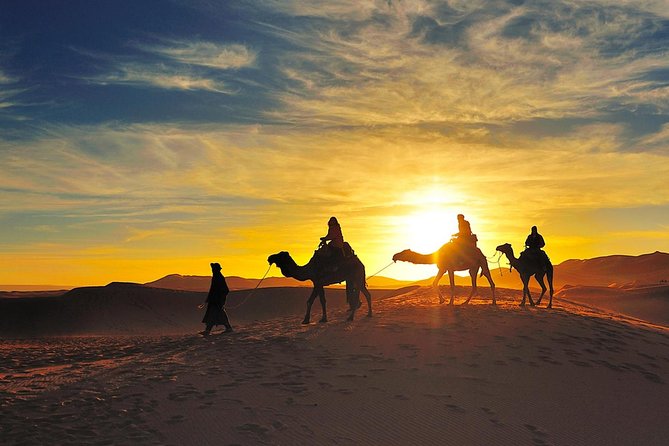
- Sahara Desert Adventure — Experience a magical camel ride through the golden dunes of Merzouga and spend a night in a luxury desert camp.
- Explore Imperial Cities — Discover the cultural and historical treasures of Marrakech, Fes, Rabat and Casablanca.
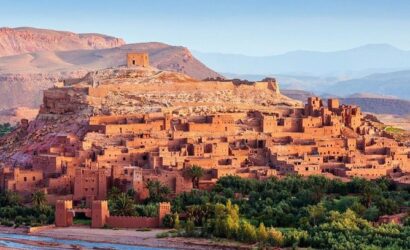
- Atlas Mountains & Aït Ben Haddou — Cross the spectacular High Atlas Mountains and visit the UNESCO-listed Aït Ben Haddou.
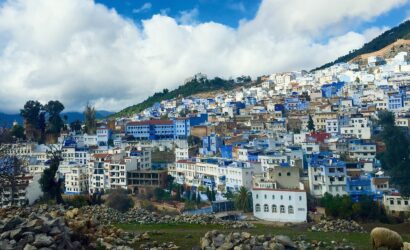
- Chefchaouen & Northern Morocco — Explore the famous Blue City, Tangier and the meeting point of the Mediterranean and Atlantic.
Itinerary
Arrive at Casablanca airport, the economic capital of Morocco and its largest city. Warm reception by your English speaking driver/guide, then transfer to the hotel. Check in at your hotel to relax. Enjoy the rest of the day at leisure. Optional dinner. Overnight in Casablanca.
Breakfast in the hotel. Enjoy the city tour of Casablanca. Begin with an inside visit of Hassan II mosque, the largest mosque in the country and one of the largest mosques in the world. Continue to Ain Diab Corniche for a pleasant stroll along the coast. Your next stop is Mohammed V Square. Enjoy sometime at leisure at Morocco Mall. Optional lunch at a local restaurant. Late in the afternoon, transfer to Marrakech, “Paris of the Sahara” as Winston Churchill once described it. Optional dinner. Overnight in Marrakech.
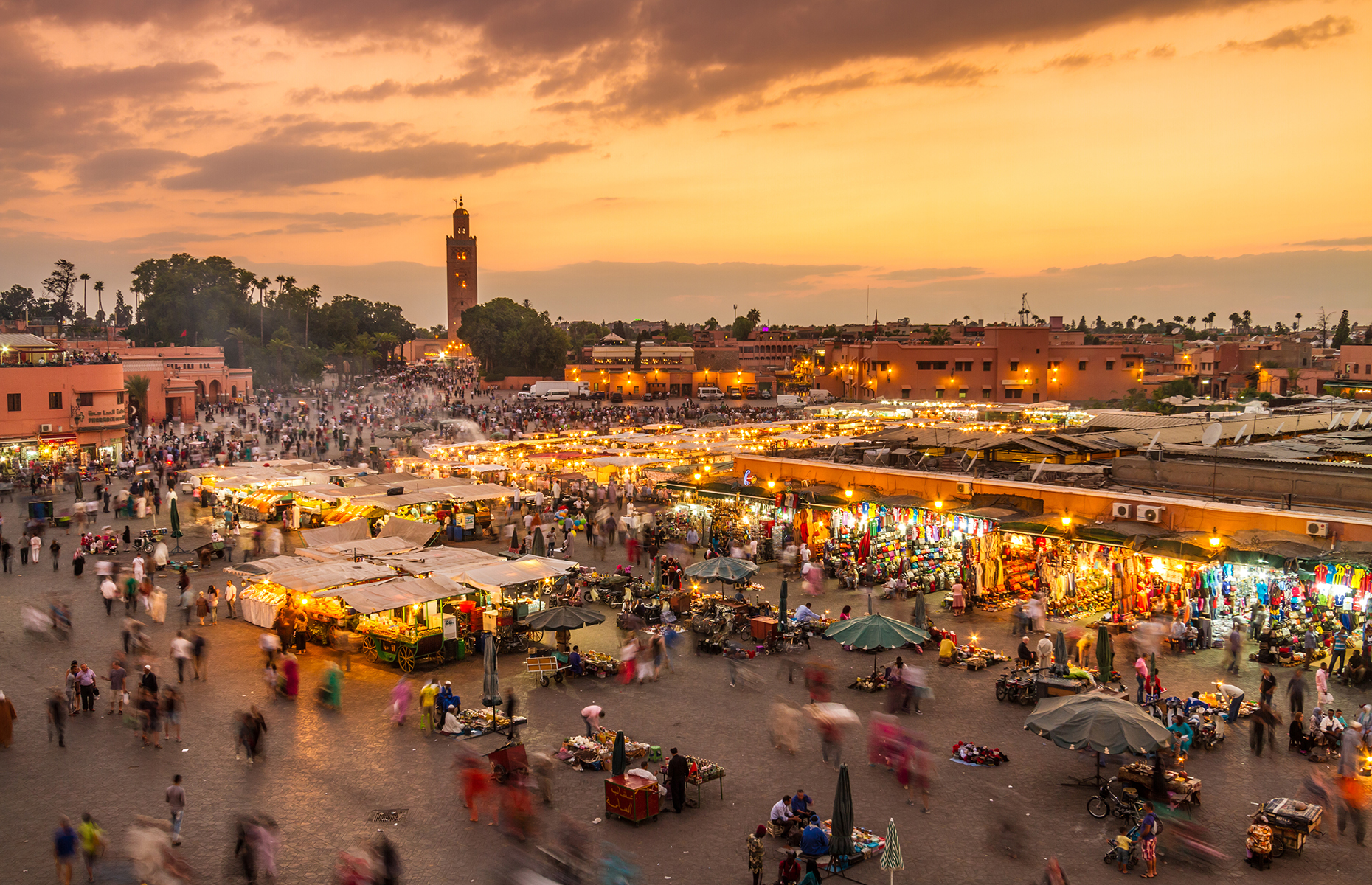
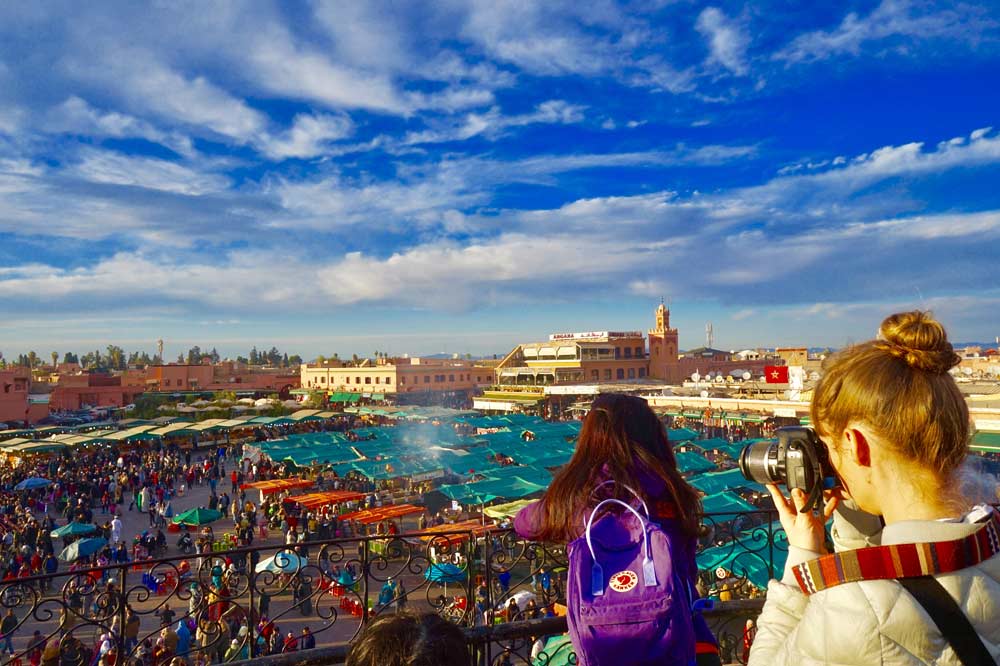
Breakfast in the hotel. Enjoy the guided city tour of Marrakech. Stop first at the Koutoubia Mosque, which is an old monument built under the reign of the Almohad Caliph Yaqub al-Mansur (1184 to 1199). This monument inspired other buildings such as the Giralda in Seville in Spain and the Hassan Tower in Rabat. Stop next at the Bahia Palace. This Palace was built in the late 19th century and was intended to capture the essence of the Islamic and Moroccan style. Visit Madrasa Ben Youssef after that. This Coranic school is named after the Almoravid Sultan Ali Ibn Yusuf (reigned 1106–1142). Madrasa Ben Youssef is the largest in all of Morocco. Stop next at the Saadian tombs, which is a site that dates back to the time of the sultan Ahmad al-Mansur (1578-1603). The tombs were discovered in 1917 and were restored by the Beaux-arts service. Optional lunch at a local restaurant. Continue the tour with the world famous Jema El Fna Square where you will enjoy amazing performance of traditional activities by storytellers, snake charmers, peddlers of traditional medicines.Your last stop is the bustling souks in the old medina. Optional dinner. Overnight in Marrakech.
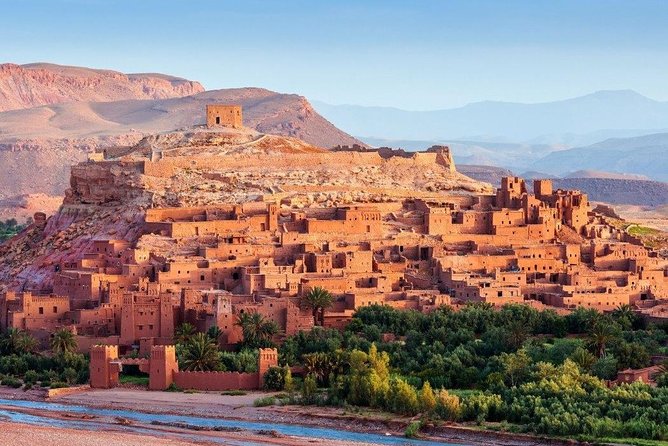
Breakfast in the hotel. Leave Marrakech through the spectacular High Atlas Mountains to Ouarzazate. Stop at the spectacular fortress of Ait Ben Haddou. The village is a great example of earthen clay architecture that has been a UNESCO World Heritage Site since 1987. Ait Ben Haddou is an iconic landscape immortalized in such films as “The Man Who Would Be King (film) (1975)”, “Jesus of Nazareth (1977)”, “The Last Temptation of Christ (1988)”, “Gladiator (2000)”, “Son of God (film) (2014)”, ect. Optional lunch at a local restaurant. Continue to Ouarzazate, also known as “Morocco’s Hollywood”. Stop at the film studios where some of the most famous desert landscapes were and are still being shot. Visit Taourirt Kasbah, which is considered one of the most beautiful kasbahs in Morocco. Dinner in the hotel. Overnight in Ouarzazate.
Breakfast in the hotel. Leave Ouarzazate, heading to the heart of the Sahara desert. The drive is spectacular, with hundreds of Kasbahs lining the route. Stop first at Kelaat M’Gouna, a big town which is famous for cultivating roses. Expect to find many fine, rose-infused products there. Continue to Dades which is known as valley of figs. Dades valley featured prominently in a 2012 advertisement for the Cadillac CTS. Leave Dades to Tinghir. The drive is spectacular, winding through stunning desert landscapes, villages with the expansive Jebel Sarhro lunar-scape. Tinghir is a gorgeous 40km oasis, which boasts one of the largest palm groves in the country. Stop at the famous Todra Gorge, a 300m wall, carved deep into the High Atlas Mountains. Thanks to its robust rock sides with many uneven surfaces, Todra Gorge is popular among rock climbers. More than 150 routes rated French Grade 5+ to 8 have been bolted in the canyon. Todra Gorge was featured on the premiere of the United States reality showExpedition Impossible. Optional lunch at a local restaurant. Transfer to Merzouga, which is the heart of the desert. Enjoy a sunset camel ride to your charming desert camp by the dunes. Dinner in the Desert Camp. Overnight in Merzouga.
Breakfast in the hotel. Transfer to Fes, which is the spiritual capital of Morocco. The drive takes your through many Amazigh (Berber) villages and along the Ziz valley. Arrive at Midelt, a Berber town in the high plains between the Middle Atlas and the High Atlas mountains ranges. Midelt is one of Morocco’s principal cities for the mining of several minerals. Optional lunch at a local restaurant. Continue through the Middle Atlas Mountains. Stop first in Ifrane, a charming town and ski resort. Ifrane is famous for its Alpine climate, European-style houses and its 1665 metres (5,460 ft) in elevation. The town experiences snow during winter months and a cool climate during summer. Ifrane is also the place where the lowest temperature was ever recorded in Africa, -24 °C in 1935. While in Ifrane, expect to find animals like the threatened Barbary Macaque and local tree species such as the native Atlas cedar, Scrub oak and the introduced London plane. Late in the afternoon, arrive to Fes. Optional dinner in the hotel. Overnight in Fes.
Breakfast in the hotel. Enjoy the guided city tour of Fes. Begin with the entrance to the largest royal palace in Morocco. Continue with a panoramic view of the ancient medina. Enjoy an authentic experience at the traditional ceramic crafts village of Fes after that. Your next stop is Fes El Bali, the ancient town or Medina, which is a medieval part of Fes that has not changed for centuries. Optional lunch at a local restaurant. Visit the famous Al-Karaouine mosque, built by Fatima Al Fihria in 857. Al-Karaouine mosque became home to the University of Al-Karaouine, which is the first university in the world and the world’s foremost center of learning at the beginning of the second millennium. The university was built by Fatima Al Fihria in 859, and, since then, it has become one of the leading spiritual and educational centers of the Muslim world. In the medina, visit also a Merdersa, which is a Coranic school. Complete the city tour of Fes with the leather Souq and the oldest Leather Tannery in the world. The tannery dates back at least nine centuries. Optional dinner. Overnight in Fes.
Breakfast in the hotel. Transfer to Meknes, “Moroccan Versailles” and one of the oldest cities in the kingdom. Meknes was the capital of Morocco under the reign of Moulay Ismail (1672–1727), a contemporary of Louis XIV, before it was relocated to Marrakesh. Stop at the massive Bab El Mansour gate, which is the grandest of all imperial Moroccan gateways. Bab El Mansour gate was completed by Moulay Ismail’s son, Moulay Abdallah, in 1732. Stop next at Hri Souani, which is a complex of three different buildings built for granaries and stables. This amazing site has been used as a scene for many films, the most famous of which is probably “The Last Temptation of Christ” in 1988 by Martin Scorsese. Continue to the UNESCO-sponsored Roman ruins in Volubilis, a Berber and Roman city partly excavated by the UNESCO. Volubilis was considered as the ancient capital of the Kingdom of Mauretania. The city was developed from the 3rd century BC onward as an Amazigh, then proto-Carthaginian, and from the 1st century AD onward, the city grew rapidly under the Roman rule. Optional lunch at a local restaurant. Transfer to Chefchaouen, the “Blue City” and one of the most majestic places to visit in Morocco. Optional dinner. Overnight in Chefchaouen.
Breakfast in the hotel. Enjoy the city tour of Chefchaouen. Start your tour with the kasbah of Chefchaouen. This kasbah belongs to the early 18th century, and was built by the legendary ruler Moulay Ismail (1645 – 1727). Stop next at Plaza Uta el-Hammam, which is the cobbled main square in town and where the striking 15th century Grand Mosque sits. Transfer to Tangier, the pearl of the north of Morocco and the country’s main gate to Europe. Enjoy the city tour of Tangier. Stop first at the old town, locally called “The medina”. Visit the American legation, Dar El Oued Makhazen Kasbah, the Mendoubia Gardens, and the Grand and Petit Socco. Transfer to Cape Spartel after that, the meeting point of the Mediterranean Sea and the Atlantic Ocean. Cape Spartel was known to the Greeks and Romans as the “Cape of the Vines”. Visit the Cave of Hercules, which is Africa’s most north-westerly promontory with a strange sea window shaped like a map of Africa. Optional lunch at a local restaurant. Transfer to Rabat, the capital of Morocco and one of the country’s imperial cities. Optional dinner. Overnight in Rabat.
Breakfast in the hotel. Enjoy the city tour of Rabat. Visit the Kasbah of the Oudayas. This Kasbah was constructed during the realm of the Almohads dynasty (12th century). Stop next at Mohammed V Mausoleum, which is home to the tombs of the current king’s father and grandfather. Your last stop in Rabat is Hassan Tower, which is a minaret built in 1195. Optional lunch at a local restaurant. In the afternoon, transfer to Casablanca. Optional dinner. Overnight in Casablanca.
Breakfast in the hotel. Transfer to Casablanca airport for your flight back home.
Cost
The Cost Includes
- Private transportation throughout the tour
- English-speaking driver
- Daily breakfast
- Guided tour in Marrakech
- Guided tour in Fes
- Guided visit to Volubilis
- Dinner in Boumalne Dades
- Camel ride in Merzouga
- Overnight stay in a desert camp in Merzouga
- Dinner at the desert camp
- Breakfast at the desert camp
- Sunset & sunrise experience in the Sahara
The Cost Excludes
- International Airfare
- Visa Charges
- Hotel Expenses(In Morocco, some packages do include hotel expenses)
- Your travel and medical insurance
- Personal Expenses such as shopping, bar bills, hot shower, telephone, laundry, titbits etc
- Food and accommodations in Morocco
- Services not mentioned or not promised by the agent/agency
- Emergency expenses such as expenses on chartered helicopter.
Frequently Asked Questions (FAQs)
Annapurna Base Camp is a Grade B or a moderately difficult trekking route. So any fit person can do this trek, even if you do not have any previous experience. You should be aware of what to expect and mentally prepare for it. Then, as long as you will too, you can.
On average, you walk about 4 to 6 hours per day. One or two days can be as less as 3hrs and one or two days can be as long as 7hrs.
The highest altitude reached is 4190m. This is the elevation of Annapurna Base Camp. ABC is the highest we will climb in this trek.
Yes, you can charge batteries en route. Charger should be brought. There are hot shower facilities as well. You may have to pay a certain amount for both ($1-$2). Negotiate. Also, a hot water facility could be free at a lower elevation.
No. There are no ATMs on this trek route. You will have to draw enough cash in Pokhara or Kathmandu. There are a number of ATMs in these cities. Everything is paid in Nepali rupees. So money should be exchanged before the start of the trek.
Yes. The Internet can be accessed in most places. Sometimes, there might be some technical problems. The Internet in Nepal is not as fast as you are used to and at times you can just lose connection.
Not really. It depends on you. If you want, ABC trekking can be done independently. You could hire a guide and a porter by yourself instead of going through an agency or not hire a guide at all. Although, not having a guide can be a little problematic during the offseason.
It really depends on you. Is it your first time in Nepal? How confident are you of being able to find your way around? How pressed on time are you? If you go through an agency, it will be costlier but everything will be planned. You will only have to come, trek and return.
For the Annapurna region, pay for guides range from $20 to $30 per day and porters take $15 to $25 per day.